Who hasn’t heard of the world-famous Samaria Gorge, nestled within the White Mountains? Declared a National Park of Greece in 1962, it was later recognized as a UNESCO World Biosphere Reserve. In the middle of the gorge lies the abandoned village of Samaria. Today, it serves as a base for personnel from the NECCA Management Unit and the Forestry Service, who reside there for much of the year alongside the Park’s working equines.
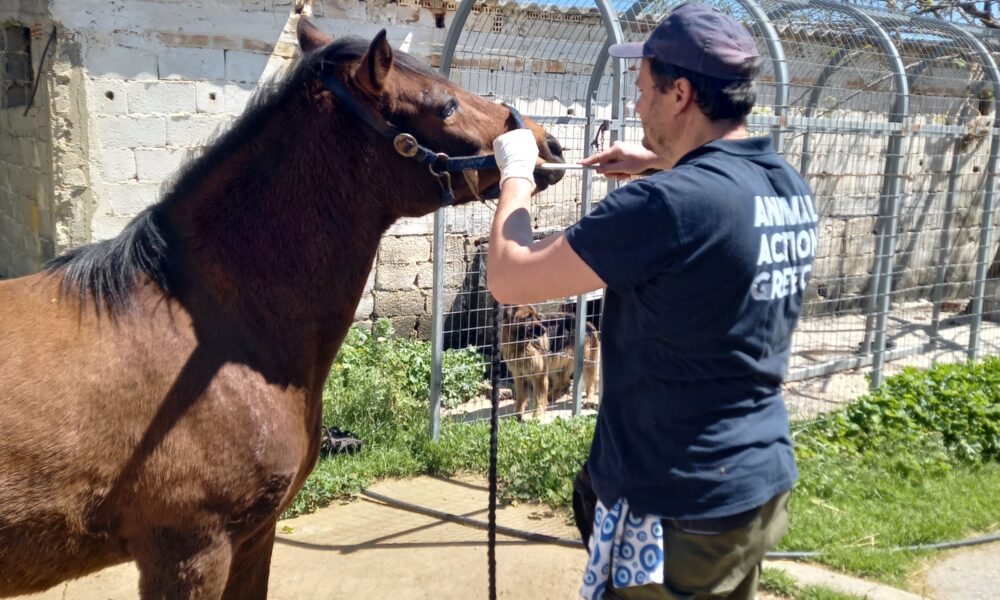
The Samaria Gorge—its unique natural environment, its people and the animals that work within it—has held a special place in our equine dental technician’s heart. It is a particular privilege and joy for him to provide annual care – on behalf of Animal Action Greece – to the working equines of Samaria National Forest Park. This year, he visited them on April 7, prior to their transfer into the gorge, at the riding school facilities where they are kept during the winter months to rest until mid-spring. Farrier and general veterinary services are no longer requested annually to Animal Action Greece, as the MMU now works with its own local collaborators. However, specialised equine veterinary support is occasionally requested from Elisa Geskou, veterinarian and Equine Care Programme Coordinator, to ensure the continued welfare of the animals.
Alkis examined and treated the same eight animals seen last year, along with three additional newcomers. Although the latter were initially thought to be juveniles, dental age assessment revealed them to be young adults also requiring treatment. All animals behaved exceptionally well, allowing Alkis to carry out thorough examinations and address even minor issues. Two of the retired mules – one nearly forty years old –were found to have a low body condition score. While resolving their dental problems will certainly help, they will also require a carefully managed diet tailored to elderly equines. Most animals presented routine conditions such as sharp enamel points; minor hooks and pointed caudal ramps were also observed, along with ATR and step teeth. Dental calculus – an often overlooked but potentially serious mineral deposit if left untreated – was removed from several canine teeth and incisors, helping to protect the animals from gingivitis.
Dental care is essential for equines, as it directly affects their ability to eat, digest and maintain a healthy body condition. Untreated dental issues can lead to weight loss, reduced performance and life-threatening conditions such as colic. For this reason, routine floating, calculus removal and the treatment of dental health issues and abnormalities are vital to ensuring comfort and long-term well-being in these hard-working animals.
We express our appreciation to the Management Unit for recognizing the importance of preventive health and welfare in working equines and for formally incorporating dental care into their annual care programme.
At Animal Action Greece, we remain committed to supporting the working equines of the Gorge by offering our expertise whenever required.